
The level of Total Polar Compounds (TPC) in cooking oils, at which they are considered for discard, is typically set between 24–27 g per 100 g. European countries set the discard limit at approximately 24%, Australia and New Zealand at 25%, and several Asian countries at around 27%.
The Food Safety and Standards Authority of India (FSSAI) sets a maximum limit of 25% for Total Polar Compounds (TPC) in cooking oils.
When the Total Polar Compounds in cooking oil cross this recommended mark (25%), the oil is no longer considered safe for human consumption. Even if you have the best cooking oils in India, the effect of degradation is same when you repeatedly heat oils and reuse them. Using reused cooking oils repeatedly forms total polar compounds, which causes hypertension, liver disease, atherosclerosis, Alzheimer’s disease etc.
What is TPC in Cooking Oil?
Total Polar Compounds, also known as Total Polar Materials (TPM), is considered one of the most authentic ways to assess the quality of cooking oil according to the German Society for Fats Science (DGF). Total Polar Compounds (TPC) are an authentic indicator of degraded oil, confirming the presence of polar compounds. When the presence of Total Polar Compounds is confirmed, it means that the cooking oil was heated or reheated at high temperatures, which caused the formation of harmful chemical components such as free fatty acids, monoacylglycerols and diacylglycerols, oxidized triglyceride monomers, triglyceride dimers and polymers, and secondary oxidation products.
Total Polar Compounds are an indicator used to assess the quality and degradation level of frying oil, which occurs due to oxidation, hydrolysis, and polymerization.
The total count of polar compounds present in cooking oil is the actual reading that Total Polar Compounds provide when lab tested.
If Total Polar Compounds exceed 25% of the total weight of the oil, it means the cooking oil has degraded and is harmful for human consumption.
Buying the best cooking oils in India doesn’t protect against degradation if repeatedly used. Even the healthiest oil will degrade, forming polar compounds if reused multiple times for frying.
Why FSSAI Sets the 25% TPC Limit
The Food Safety and Standards Authority of India (FSSAI) has clearly prohibited the use of edible/vegetable oil having TPCs of more than 25%.
Cooking oils with +25% TPC levels are considered harmful for human consumption. For fresh or unused oil, the suggested TPC limit is set below 15%.
The Total Polar Compounds limitation by the regulator is set based on scientific evidence that confirms negative health impacts from using degraded cooking oils. Apart from India, other countries have also set strict limitations on TPC levels, which range between 24% and 27%.
How Cooking Oil Becomes Unsafe with High TPC
Polar compounds are naturally present in fresh cooking oils, but in small amounts. However, their number increases and becomes harmful when thermal oxidation occurs. When oil is repeatedly heated and reused, especially for frying, moisture in the environment comes into contact with the oil, which speeds up oxidation and breaks the molecular structure. This process, which also involves hydrolysis and polymerization along with oxidation, forms a large number of Total Polar Compounds. When this happens, it is confirmed that the oil has already degraded and is no longer suitable for human consumption. Polar compounds increase when oil is reused multiple times, crossing the safe limit far beyond the 25% mark.
Hidden Health Risks of Using Oil Above 25% TPC
Even the best cooking oil for heart health in India won’t be able to provide protection once polar compounds are formed due to repeatedly heating or reusing oil for deep frying. Once the Total Polar Compounds in cooking oil are formed, i.e., above 25%, these adversely impact the heart, liver, and kidneys. On consumption of degraded cooking oil, the polar compounds in it trigger oxidative stress and chronic inflammation, which further leads to arterial blockage, clogging of the arteries, hypertension, and increases the risk of heart disease and stroke. These compounds make it quite difficult for the liver and kidneys to process them for detoxification, which often causes non-alcoholic fatty liver disease. Aldehydes, carcinogens, and neurotoxins are polar compounds known to damage DNA and may also deteriorate cells, causing cancer. Regular consumption of cooking oil that is repeatedly used and high in TPC may disrupt insulin resistance, contributing to Type 2 diabetes.
In a report by The Economic Times (ETHealthworld.com), Dr. Amit Javed, Director of Gastrointestinal Surgeries at CK Birla Hospital, confirms that most polar compounds are carcinogenic, and regular consumption may cause stomach cancer and cancer of the food pipe.
Street Food: A Major Source of High TPC Oils
Using reused oil at home may cause fewer health issues than consuming street food fried in repeatedly heated cooking oil. Many street vendors use the same oil, heating it multiple times. This constant heating and cooling triggers oxidation and polymerization, which raises the Total Polar Compounds in cooking oils. Many street vendors practice topping up degraded, reused oil with fresh oil. This method does not manage or reset the TPC level; rather, it speeds up the degradation of the fresh oil. Many vendors buy used cooking oil (UCO) from large restaurants, which may be near or beyond the legal 25% TPC limit. This may be used one time if below the 25% mark, but above it, it is harmful.
The Observer Research Foundation, in its 2022 publication report, ‘Diversion of Used Cooking Oil into the Food Stream: A Study of Four Indian Cities,’ highlights that nearly 60% of used cooking oils are diverted back into the food chain, which includes sale to street vendors.
Even if street vendors claim to use the best cooking oils in India, avoid buying fried food items from them, as it is most likely that the oil is repeatedly heated.
How Total Polar Compounds (TPC) Are Tested in Cooking Oil
To assess the quality of cooking with regards to the presence of Total Polar Compounds, especially for levels above 25%, there are two methods. Laboratory method is the most accurate and the other is rapid testing..
Laboratory Testing (Most Accurate Method)
This is the most accurate testing method to check the levels of Total Polar Compounds adopted by the food authorities.
Column Chromatography (AOAC Method)
A small oil sample is passed through a special material (silica). This process separates degraded (polar) compounds from the rest of the oil. By comparing weights before and after separation, the exact TPC level is calculated.
FSSAI Method (India)
In India, the Food Safety and Standards Authority of India follows a detailed testing method (Method 02.051:2021), which is aligned with global standards.
ISO Standard
Globally, the International Organization for Standardization also provides a standard method (ISO 8420) to measure polar compounds in oils.
The above methods are considered highly accurate but require lab setup, time, and trained professionals.
Rapid Testing
Since many don’t have access to lab testing, having quick testing tools are useful for regular monitoring.
Handheld TPC Meters
These devices check oil quality instantly by measuring changes in the oil’s properties as it degrades.
Popular Devices
- Testo 270 – Gives results in under a minute with easy colour signals – Green (safe), Amber (borderline), Red (discard). This device costs between Rs 40000 to Rs 55000 in India.
- Ebro FOM 330 – Measures both oil quality and temperature directly in hot oil. The cost of this device in India is around Rs 79,940.
Test Strips/Kits
These are simple strips that change colour depending on oil quality. They are less precise but useful for quick checks in small kitchens.
These methods are faster and easier but are usually calibrated using lab standards for accuracy.
Easy Signs That Your Cooking Oil Has Crossed the Danger Limit
Experience play a major role in identifying the quality of oil while cooking. Here are some noticeable changes that signals your cooking has degraded.
- The oil has turned noticeably darker than when you bought it.
- It produces thick smoke even at moderate temperatures.
- A strong, unpleasant or rancid smell appears when heating.
- Excessive foaming occurs when food is added.
- The oil feels sticky or leaves a residue on utensils.
- Fried food does not turn crisp and instead absorbs more oil.
If you come across these signs, it is time to discard the cooking oil.
Common Mistakes That Push TPC Levels Higher
To avoid degradation of cooking oil and to keep TPC levels below 25%, abstain from doing these things in your kitchen:
- Repeatedly reusing the same oil, especially for frying.
- High-heating cooking oil beyond its smoke point for deep frying.
- Leaving food particles in the oil instead of scooping them out after use.
- Mixing fresh oil with used oil.
- Choosing oils that are not stable enough for high-heat cooking.
Avoiding these mistakes can help keep TPC levels under control for longer.
Cold-Pressed Oils and TPC – Are They a Better Choice?
When it comes to managing Total Polar Compounds in cooking oil, cold-pressed oils are best to go with. These oils are naturally produced, mechanically pressed, at low temperatures without chemical processing or solvent extraction. As a result, they start with much lower TPC levels, often between 2% and 5%.
More importantly, cold-pressed oils retain most of their natural antioxidants, such as vitamin E and polyphenols. These compounds act as a shield and slow down oxidation and other degradation processes due to their oxidative-resistive properties. This means the oil resists building up polar compounds for longer compared to highly refined oils that lose these protective elements during processing.
However, it is worth noting that only the best cold-pressed oils in India from reputed oil brands offer better resistance against oxidation. This is because these healthy and naturally processed oils are not adulterated; rather, they are of pure quality.
Since cold-pressed oils have slightly lower smoke points, while cooking, one needs to be attentive about the temperature.
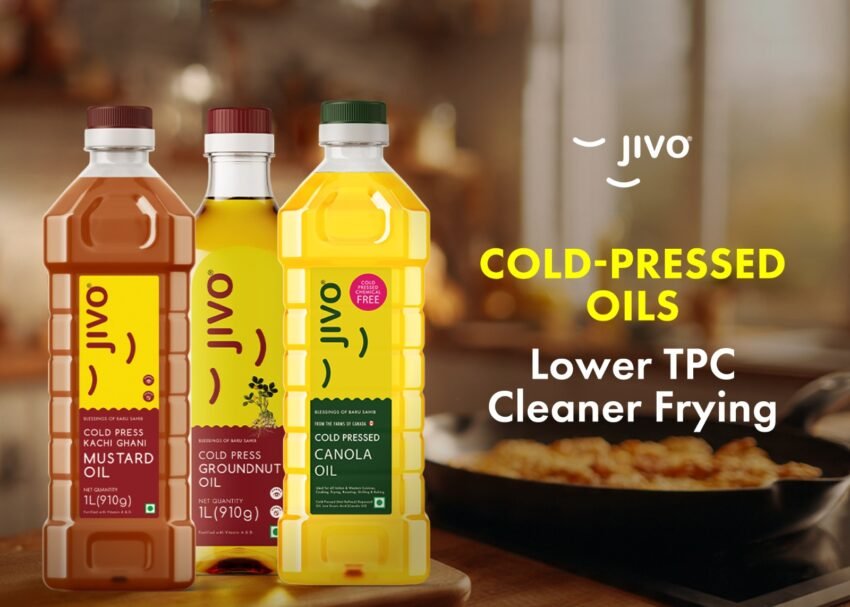
For frying, one may go for cold-pressed canola oil, cold-pressed kachi ghani mustard oil, cold-pressed groundnut oil, and first-pressed sesame oil from the best cold-pressed oil brands in India, like Jivo.
Also Read: What are cold pressed oils? How do these best oils benefit health?
Conclusion
Many know about smoke point, but very few are aware of Total Polar Compounds in cooking oils, including the 25% safe limit. Once the Total Polar Compounds cross the safe limit, the oil starts to degrade, forming harmful compounds that adversely impact health, especially the heart. Buying a fresh batch of cooking oils, especially cold-pressed, ensures low TPC levels. Avoid heating oils beyond their smoke point and trust the best cold-pressed oils from reputed oil brands in India, like Jivo.