
Why This Question Confuses So Many Indian Home Cooks
A typical Indian kitchen rarely sticks to just one style of cooking. You might prepare tadka for dal in the morning, shallow fry parathas for breakfast, and deep fry pakoras or pooris over the weekend. Since each method uses heat differently, many people start wondering whether they should also be changing their cooking oil every time.
This is where the confusion begins. Some believe mustard oil is the best cooking oil for frying, while others prefer sunflower, groundnut or rice bran oil. Then there are endless videos and social media posts claiming that one oil is perfect for every dish, while another says the same oil should never be used for frying. With so many opinions around, it becomes difficult to know what is actually true.
The good news is that you don’t need to make your decision based on trends or popular opinions. The answer depends on how deep frying, shallow frying and tadka affect the oil, and whether the oil can handle the heat involved. Once you understand that, choosing the right cooking oil becomes much simpler.
Understanding How Different Cooking Methods Use Heat
Before choosing the best oil for deep frying or the best oil for tadka, it’s important to understand how these cooking methods actually work. Although they all involve heating oil, they don’t expose it to the same temperature or for the same amount of time.
For example, deep frying keeps oil hot for several minutes, while tadka needs only a quick burst of heat. Shallow frying and everyday cooking fall somewhere in between. Since every cooking method places different demands on the oil, understanding these differences can help you choose the right cooking oil for your kitchen.
Deep Frying
Deep frying is usually done at temperatures between 175 to 190 degrees Celsius. In this method, the food is completely immersed in hot oil, which stays at a high temperature for several minutes. If you’re frying several batches of samosas, puris or pakoras, the oil remains on the heat for even longer.
Since the oil is exposed to continuous high temperatures and is often reused for the next batch, deep frying puts the most stress on it. That’s why many people look for a high smoke point cooking oil for deep frying. An oil that can handle high heat without breaking down too quickly is generally a better choice for this cooking method.
Shallow Frying
Shallow frying, commonly used for parathas, cutlets, tikkis and pakoras, requires much less oil than deep frying. Even so, the oil stays on the heat for quite some time, especially when you’re cooking several batches one after another.
The way the oil works is also different. Since the food is only partially covered with oil, one side cooks in direct contact with the hot oil while the other side cooks as it’s turned over. It’s also common to add a little more oil between batches, which means the oil continues to stay on the heat throughout the cooking process.
Tadka (Tempering)
Tadka works quite differently from deep or shallow frying. Here, the oil is heated for a short time, usually less than a minute, just enough to crackle mustard seeds or bring out the aroma of cumin, hing and curry leaves. Although the heat can be quite high, the oil is exposed to it only for a few seconds.
What makes tadka special is that the oil does more than just cook the spices. It helps release their aroma and spreads their flavour throughout the dish. That’s why choosing the right oil for tadka is often about finding the right balance between flavour and heat tolerance.
Sautéing and Everyday Cooking
Most everyday Indian cooking, whether it’s making sabzis, dals or regular sautéing, is done over moderate heat. The temperature is usually lower than deep frying, but the oil stays on the flame for a longer time as the food cooks.
Unlike deep frying, the oil isn’t exposed to very high heat all at once. Instead, it is heated steadily throughout the cooking process. That’s why a cooking oil that performs well at moderate temperatures is usually suitable for everyday meals.
ALSO READ: Which Oils are Best for High Heat Cooking in India?
Does Every Cooking Method Need a Different Cooking Oil?
The Short Answer
Not always. You don’t need a separate bottle of oil for every dish you prepare. What matters more is whether your cooking oil is suitable for the type of cooking you do most often, especially the temperature and how long the oil stays on the heat.
When One Good Cooking Oil Is Enough
If your daily cooking mainly includes sautéing, tadka and occasional shallow frying, one good quality cooking oil with good heat stability is usually enough. That’s why the answer to the question, “can one oil be used for all cooking,” is often yes, provided the oil has a reasonably high smoke point and a balanced fat composition.
Situations Where Changing Oils Makes Sense
Where it does make sense to have a second oil on hand is deep frying, especially if you fry often or in large quantities. Since deep frying puts more stress on oil due to prolonged heat and repeated use, having an oil specifically suited for high heat frying, alongside your everyday cooking oil, is a more practical approach than trying to make one oil do everything at every extreme.
ALSO READ: What are the best cooking oils in India?
Is Smoke Point the Most Important Factor?
What Is Smoke Point?
Smoke point is simply the temperature at which oil starts to break down and release visible smoke. Once oil crosses this point, it does not just taste burnt, it also starts forming compounds that are not great for your health if consumed regularly.
Why Smoke Point Matters for Frying
For deep frying and tadka, where oil is exposed to high heat, a higher smoke point gives you a comfortable safety margin. This is why so many people search for a high smoke point cooking oil specifically when they are choosing oil for frying rather than for everyday sautéing.
Why Smoke Point Alone Doesn’t Decide the Best Cooking Oil
Here is where most kitchen conversations stop, but the full picture goes a bit deeper.
Oxidative stability matters just as much, if not more. This refers to how well an oil resists breaking down when heated repeatedly, which happens all the time in Indian kitchens where frying oil often gets reused. As the British Heart Foundation’s nutrition team explains, a high smoke point alone does not automatically mean an oil is stable or healthy under heat, the type of fat matters just as much.
Fat composition plays a big role too. Oils higher in monounsaturated fats tend to hold up better under heat compared to oils that are mostly polyunsaturated fat, even if both have similar smoke points on paper, since polyunsaturated fats contain more of the weaker double bonds that break apart easily when heated. Saturated fats are generally the most heat stable, which is part of why ghee performs so reliably at high temperatures.
Cooking duration matters as well. An oil that performs fine for a quick tadka might not be the best choice for a long deep frying session, purely because of how much time it spends at high heat.
And reusing oil, something almost every Indian household does to avoid waste, accelerates the breakdown process regardless of the original smoke point, which is exactly why an oil with good natural stability tends to age better across multiple fries.
What Makes a Cooking Oil Suitable for Indian Cooking?
Heat Stability
An oil suitable for Indian cooking needs to hold up across a wide range of methods, from a quick tadka to a longer frying session, without breaking down too quickly.
Fat Composition (MUFA, PUFA & Saturated Fat)
A good balance of monounsaturated, polyunsaturated and saturated fat generally makes an oil more versatile and better suited to withstand the varied heat levels used in Indian kitchens.
Flavour Compatibility
Indian cooking relies heavily on oil to carry flavour, especially in tadka, so the oil needs to complement, not overpower, the spices being used.
Nutritional Quality
Beyond heat performance, the oil should ideally retain some of its natural nutritional value rather than being stripped down through heavy processing.
Smoke Point
And of course, a reasonably high smoke point remains a useful, though not the only, marker for how well an oil will perform under the heat levels common in Indian cooking.
Best Cooking Oils for Different Indian Cooking Methods
| Cooking Method | What to Look For | Suitable Oil Characteristics |
| Deep Frying | High heat stability | Higher smoke point, stable fats |
| Shallow Frying | Balanced stability | Moderate to high smoke point |
| Tadka | Good flavour and quick heating | Stable oil with suitable flavour |
| Stir Fry | High heat tolerance | Stable oil |
| Everyday Cooking | Balanced nutrition | Stable fat profile |
Best Oils for Deep Frying, Shallow Frying and Tadka, With Their Smoke Points
Numbers make this whole topic much easier to act on, so here is a practical breakdown of oils that genuinely work well for each cooking method, along with their approximate smoke points. These figures are drawn from Wikipedia’s compiled smoke point data, sourced from peer reviewed food technology references, and from Harvard Health Publishing’s guide to cooking oils.
Best oil for deep frying
Refined groundnut oil, with a smoke point of around 232°C, is one of the most dependable choices for deep frying puris, samosas and bhajiyas, since it comfortably handles sustained high heat.
Refined rice bran oil, also around 232°C, is another strong option, and it carries the added benefit of oryzanol, a natural antioxidant that supports its stability during frying.
Refined sunflower oil sits close by too, with a smoke point of roughly 227 to 254°C depending on how refined it is, though as mentioned earlier, its higher polyunsaturated fat content means it does not hold up quite as well across repeated frying sessions.
Best oil for shallow frying
Mustard oil, once heated to its smoke point of around 250°C and allowed to cool slightly as is traditionally done, works beautifully for shallow frying parathas, cutlets and pakoras, largely because of its strong flavour and fairly high heat tolerance.
Refined canola oil, with a smoke point of about 204 to 230°C, is a lighter, more neutral tasting option that also performs reliably for shallow frying.
Best oil for tadka
Since tadka only needs a short burst of heat, you have more room to choose based on taste. Mustard oil is a classic choice here too, and ghee, with a smoke point of around 250°C, works wonderfully for a rich, aromatic tempering, especially in dals and kadhi.
Can You Use One Cooking Oil for Deep Frying, Shallow Frying and Tadka?
What Nutrition Experts Generally Recommend
Most nutrition guidance leans toward using an oil with a well rounded fat profile and decent heat stability as your everyday base, while keeping frying sessions shorter and less frequent rather than constantly switching oils based on the dish. Registered dietitians explain that you don’t need a very high smoke point oil for every cooking task. An oil with a moderate smoke point and a stable fat profile works well for sautéing, baking and moderate-heat roasting, while a higher smoke point is more important for frying, searing and high-heat roasting.
Choosing an Oil That Matches Most Indian Cooking Styles
Since Indian cooking moves between tadka, sautéing and occasional frying so frequently, choosing one reliable, heat stable cooking oil for Indian cooking as your primary oil makes daily cooking simpler without compromising on safety or taste.
When Rotating Oils May Be Beneficial
That said, rotating between two oils, one for everyday cooking and tadka, and a separate one specifically for deep frying, can be a smart approach if frying is a regular part of your kitchen routine, since it spreads out the fat composition benefits and avoids overworking a single bottle of oil.
Common Mistakes People Make While Frying
Heating Oil Until It Smokes
Waiting for oil to visibly smoke before adding food is a common habit in many kitchens, but by this point, the oil has usually already started breaking down, so it is better to test heat with a small piece of food instead.
Reusing Frying Oil Too Many Times
Reusing oil once or twice is generally fine, but repeated reuse over several sessions allows unwanted compounds called total polar compounds to build up steadily, even if the oil still looks and smells normal. The Food Safety and Standards Authority of India has set a regulatory limit of 25 percent total polar compounds, beyond which oil is considered unfit for use, and the Indian Council of Medical Research generally advises against reusing frying oil more than a couple of times.
Mixing Fresh and Old Oil
Topping up a pan of used oil with fresh oil might feel efficient, but it actually shortens the life of the fresh oil, since it inherits the breakdown that has already started in the older batch.
Overcrowding the Pan
Adding too much food at once drops the oil temperature suddenly, which means the food absorbs more oil instead of frying properly, leading to soggy, greasy results.
Storing Used Oil Incorrectly
Leftover frying oil should be strained and stored in a cool, dark place, since leaving it near heat or in direct sunlight speeds up oxidation even before it is used again.
ALSO READ: Why Cooking Oil with More Than 25% TPC is Not Safe for Consumption
Conclusion
So, does the oil really need to change every time you switch from deep frying to shallow frying to tadka? Not every single time, but understanding how each method uses heat definitely helps you make better choices instead of guessing.
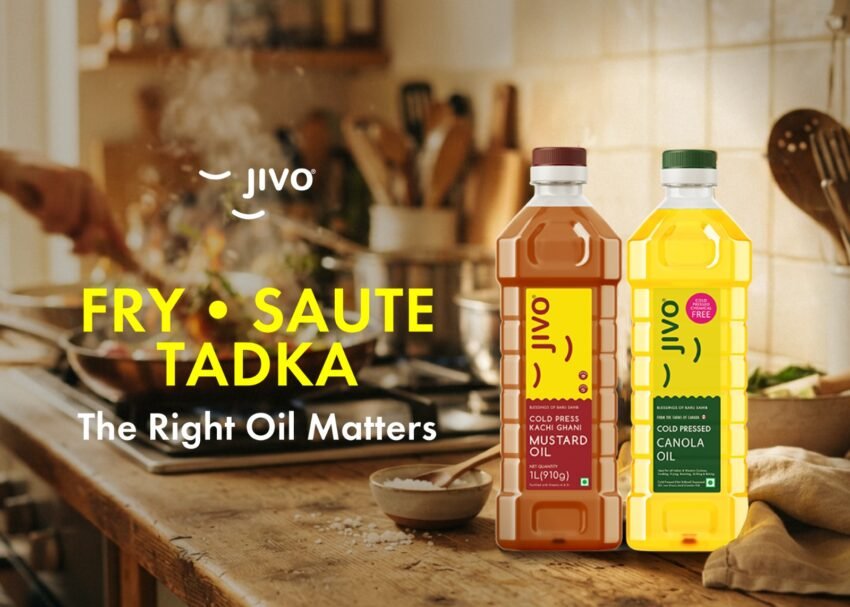
If there is one shift worth making in your kitchen, it is paying closer attention to the quality and stability of the oil itself, not just its price or popularity. This is where cold pressed oils genuinely stand out, since minimal processing helps them retain natural stability and nutrition that heavily refined oils often lose. Jivo cold pressed mustard oil and Jivo cold pressed canola oil are worth considering if you want an oil that works reliably across tadka, sautéing and everyday Indian cooking.
You may also try cooking oils free of cholesterol and trans fats, available to order online from Zepto and Blinkit for quicker delivery: Jivo EVOO and Extra Light Olive Oil.