
Ghee is one of the largest dairy categories in the country. The ghee market in India was valued at over INR 3,774 billion in 2025, and it is projected to grow further in the coming years.
Most discussion around ghee quality focuses on fat content, purity, and adulteration. One component that rarely gets discussed is a small group of molecules called phospholipids. They make up only a small fraction of ghee, but they originate from milk in a specific way and their presence depends on how the ghee is made.
Ghee is mostly triglyceride, which is fat in its simplest form. Phospholipids are minor by comparison, but they come from the milk fat globule membrane, and how much of them remain in the finished ghee depends on the process used to make it. This blog explains what phospholipids are, where they come from, and what role they play in ghee.
What Are Phospholipids
Phospholipids are a type of fat, but they are a bit different. A regular fat molecule, like the ones that make up most of your ghee, does not mix with water at all. A phospholipid molecule is built differently. One part of the molecule attracts fat and the other part attracts water. This is why scientists call them polar lipids, and according to a detailed review on milk fat phospholipids, this dual structure is what gives phospholipids their biological role.
Milk contains several types of phospholipids. The common ones are phosphatidylcholine, phosphatidylethanolamine, phosphatidylserine, phosphatidylinositol and sphingomyelin. You do not need to remember these names. What matters is understanding that they are all part of a small but important family of fat molecules found naturally in milk and its products.
Where Do Phospholipids in Ghee Come From
Each fat globule in milk is surrounded by a thin protective layer called the milk fat globule membrane, often shortened to MFGM. A comprehensive review on the MFGM describes it as a thin film on the surface of every fat globule, made up of proteins, phospholipids, sphingolipids and cholesterol.
This membrane has a functional purpose. It keeps the fat inside stable and prevents it from clumping together, and according to a review on bioactive lipids in the MFGM, it acts as a natural emulsifier while making up only two to six percent of the total mass of the fat globule.
When milk becomes curd or cream, then butter, and finally ghee, this membrane gets disturbed at every stage. Churning breaks it apart, and its components then scatter. Some phospholipids move into the buttermilk, some stay trapped with the milk solids, and only a portion carries forward into the finished ghee. This explains why phospholipid levels can differ between different batches of ghee.
Are Phospholipids Present in Ghee
Yes, phospholipids have been detected in ghee, though in much smaller amounts than triglycerides. It is known that ghee is composed mainly of mixed glycerides and fatty acids, with phospholipids, sterols and fat soluble vitamins appearing only in trace amounts.
A notable point is that a large share of the phospholipids originally present in milk does not make it into the final ghee. Research on ghee residue, the solid material left behind after clarification, shows that a fair share of phospholipids stays behind in that residue because of their polar nature.
What Is the Role of Phospholipids in Ghee
They Are Part of the Milk Fat Globule Membrane
As explained above, phospholipids form a structural layer around every fat droplet in milk. Their main role in this context is structural, holding the fat together and protecting it.
They Have Natural Emulsifying Properties
Since one part of a phospholipid molecule attracts water and the other attracts fat, these molecules can help fat and water mix, which plain fat cannot do on its own. This is why phospholipids extracted from dairy sources are studied for use as natural emulsifiers in food.
They Can Influence Ghee’s Flavour and Stability
Phospholipids interact with other minor compounds during the heating that happens while making ghee. Some studies suggest they play a role in how ghee resists oxidation during storage, since compounds like phosphatidylethanolamine have been observed to slow down the breakdown of unsaturated fats.
They Contribute to the Nutritional Profile of Dairy Lipids
Phospholipids are biologically active molecules and form a normal, expected part of milk fat chemistry. This does not mean ghee should be viewed as a phospholipid supplement, but their presence does add a layer of complexity to what is otherwise seen as a simple fat.
What Are the Potential Benefits of Phospholipids
It helps to be clear here. These are the roles phospholipids play as nutrients and biological molecules, not medical claims about what eating ghee does for your body.
Support Normal Cell Membrane Structure
Every cell in the human body is wrapped in a membrane built largely from phospholipids, so these molecules are fundamental to basic biology.
Role in Normal Lipid Digestion and Transport
Phospholipids assist in how fats move through the digestive system because of their ability to interact with both water and fat.
Choline Contribution from Phosphatidylcholine
Phosphatidylcholine is a natural source of choline, a nutrient the body needs in small amounts for normal function.
Role in Normal Cellular Functions
Beyond structure, phospholipids participate in cell signalling and various everyday biological processes.
Potential Contribution to the Functional Properties of Dairy Fat
Their emulsifying nature gives phospholipids a technological role too, and dairy scientists have studied MFGM derived ingredients for use in food processing, as shown in research on milk fat globule membrane ingredients.
How Does Ghee Making Affect Phospholipids
The process of converting milk into ghee involves several stages. Depending on the method used, milk may first be converted into curd or cream, followed by churning or butter-making, and the resulting butter is then heated to remove moisture and milk solids. Phospholipids, which are associated with the milk-fat globule membrane, can be distributed differently during these stages.
Churning and separation are important steps. When milk or cream is churned, the milk-fat globule membrane is disrupted, and its components can become distributed between the butter, buttermilk or other aqueous fractions. Some phospholipids can also remain associated with the material that is separated during subsequent clarification.
A study published in the Indian Journal of Dairy Science compared ghee prepared using the direct cream method and the creamery butter method. It found that the ghee residue from the direct cream method contained comparatively less phospholipid than the residue from the creamery butter method. This suggests that the method used to prepare ghee can influence how phospholipids are distributed during processing. Importantly, the study measured the phospholipid content of the ghee residue, rather than directly comparing the phospholipid content of the finished ghee.
Heat treatment during clarification is another factor. As butter is heated and moisture evaporates, milk solids separate from the fat. Some phospholipids may remain associated with these separated solids, while others can remain in or migrate into the fat phase depending on the processing conditions. Research cited in the study indicates that clarification temperature and duration can influence this distribution.
Therefore, two ghee samples made from the same milk can potentially have different phospholipid profiles when different preparation and clarification methods are used. However, the exact phospholipid content of the finished ghee needs to be established through laboratory analysis rather than inferred solely from the manufacturing method.
Do Bilona Ghee and Regular Ghee Have Different Phospholipid Content
The Bilona method is a traditional way of making ghee. In this process, milk is first fermented into curd, which is then churned to separate butter from buttermilk. The butter is subsequently heated to remove moisture and milk solids, resulting in ghee.
Commercial ghee can be produced using different methods. Depending on the manufacturer, cream may be separated mechanically, converted into butter, or processed directly before clarification. The processing conditions, including separation, churning, heating temperature and duration, can influence how milk-derived components are distributed during ghee production.
Research published in the Indian Journal of Dairy Science found differences in the phospholipid content of ghee residue produced using different preparation methods. In the study, residue from ghee prepared by the direct cream method contained less phospholipid than residue from ghee prepared using the creamery butter method. This demonstrates that the preparation method can influence the distribution of phospholipids during ghee making.
However, this research does not directly compare Bilona ghee with industrial ghee, nor does it establish that Bilona ghee contains more phospholipids. Therefore, it would not be scientifically accurate to claim that Bilona ghee is automatically higher in phospholipids without laboratory testing of the finished product.
What can reasonably be said is that ghee-making methods can affect the distribution of phospholipids and other milk-derived components. The specific phospholipid profile of Bilona or commercially produced ghee ultimately depends on the raw material and processing conditions used.
ALSO READ: How the Best Ghee in India is Made: The Bilona Method Explained
What Happens to Phospholipids in Ghee Residue
Ghee residue is the browned, solid material left behind after butter has been fully clarified. Most people either discard it or use a small amount in cooking. Research shows that this residue holds a concentrated share of the phospholipids that started out in the milk, a fact that is not widely known.
A study on extracting phospholipids from ghee residue confirms that this byproduct contains a meaningful amount of phospholipids that can be isolated and studied. Another paper on optimising phospholipid extraction from ghee residue describes ghee residue as containing a substantial quantity of phospholipids, along with useful antioxidant activity.
A separate study on enhancing phospholipid content in ghee residue concentrated phospholipids up to thirty percent on a fat basis by removing neutral lipids from the residue.
In short, the browned residue at the bottom of a ghee pot is not simply waste. A meaningful share of the phospholipids from the original milk remains in it.
Are More Phospholipids Always Better
Not necessarily. Ghee marketing sometimes overstates the importance of this point. Phospholipids are useful biological molecules, but ghee is fundamentally a triglyceride rich fat, and that is what it is meant to be. A slightly higher or lower phospholipid count does not by itself decide whether one ghee is nutritionally superior to another. Phospholipid content should not be the sole basis for judging the best ghee in India.
What matters more is overall diet, how much ghee is consumed, and the general quality and purity of the product. Phospholipid content is one small factor among several, not a standalone measure of quality.
Phospholipids in Ghee Versus Other Dairy Products
Milk carries the highest concentration of phospholipids because the fat globule membrane is still fully intact at that stage. Buttermilk, a byproduct of churning, also picks up a share of membrane derived phospholipids released during the process. Butter retains some phospholipids in both its fat and serum portions. Ghee, having gone through heating and clarification, ends up with comparatively smaller amounts remaining in the fat itself. Ghee residue, as covered above, tends to hold on to a fairly large portion. This is a relevant point to consider when comparing options for the best ghee in India, since finished ghee was never the main carrier of phospholipids to begin with.
How Much Phospholipid Does Ghee Actually Contain
There is no single fixed number here, since values differ between cow ghee and buffalo ghee, differ based on the breed of the animal, differ based on processing method, and differ based on the laboratory technique used to measure them. What the research consistently shows is that ghee itself carries a relatively small share of the phospholipids originally present in milk, while ghee residue often retains a noticeably larger portion.
This is also why, when people search for the best ghee in India, phospholipid content alone should never be the only yardstick. Purity of milk, method of preparation, absence of adulteration and overall processing care matter just as much, if not more, and this is exactly what tends to separate the best ghee brands in India from the rest of the shelf.
FAQs
Does ghee contain phospholipids?
Yes, in small amounts, since ghee comes from milk fat which naturally carries some phospholipids from the fat globule membrane.
What are phospholipids in ghee?
They are polar fat molecules originally part of the membrane surrounding milk fat globules, and a small portion of them survives into the finished ghee.
What are the benefits of phospholipids?
As biological molecules, they may help support cell membrane structure, assist lipid digestion, may contribute choline through phosphatidylcholine, and may play a role in normal cellular processes.
Does Bilona ghee contain phospholipids?
It does, and the slower, curd based churning process used in Bilona ghee making may influence phospholipid retention differently compared to fast industrial methods, though lab testing on the specific batch is the only way to confirm exact levels.
Are phospholipids found in ghee residue?
Yes, and research shows ghee residue can hold a fairly concentrated amount of phospholipids compared to the finished ghee itself.
Are phospholipids the same as saturated fat?
No, phospholipids are a completely different class of fat molecule with a unique structure, while saturated fat refers to triglycerides with saturated fatty acid chains.
Does more phospholipid mean healthier ghee?
Not automatically. Phospholipid content is only one small piece of what makes ghee good quality, and it should never be viewed in isolation when you are trying to decide which is the best ghee in India for your family.
How can phospholipid content in ghee be measured?
Laboratories typically use chromatography based methods, and some recent studies have also explored NMR spectroscopy for more detailed analysis.
Conclusion
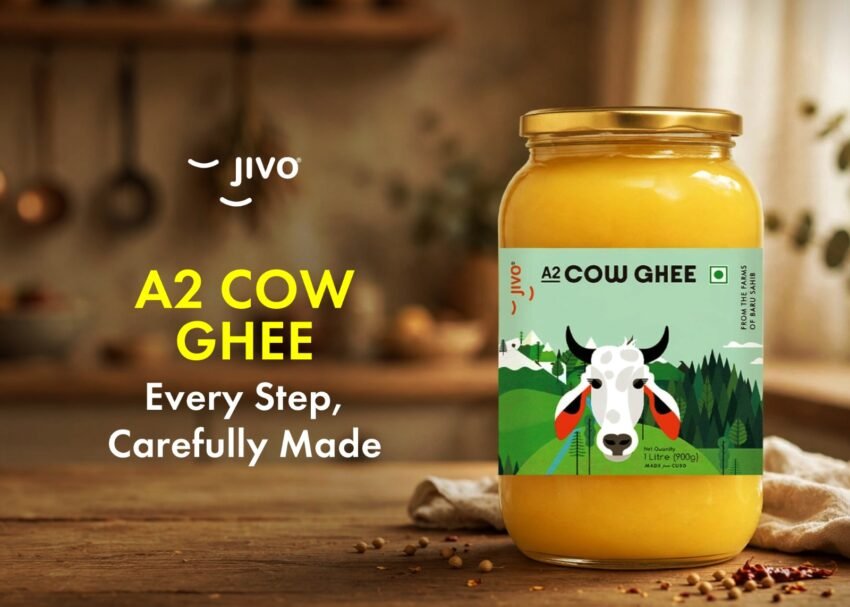
For consumers who are interested in how their ghee is made, the preparation method becomes an important part of the conversation. Traditional methods such as Bilona involve first converting milk into curd, churning the curd to separate butter, and then heating the butter to produce ghee. Each of these stages can influence how milk-derived components, including phospholipids, are distributed during processing.
This traditional approach is also one reason Bilona ghee continues to attract attention among consumers who want to know more about how their ghee is prepared. While the method itself does not prove that a ghee contains more phospholipids or is automatically nutritionally superior, it does provide a clear process from milk to finished ghee.
Brands that follow this traditional process bring that approach into a packaged product. Jivo A2 Cow Ghee is prepared from A2 cow milk through a multi-step process. The milk is first converted into curd, which is then churned to separate the butter. The butter is subsequently clarified to produce ghee.got there can be just as important.