
The global edible oil consumption represents an annual growth rate of 0.9%, estimated to reach 239 million metric tons by 2028. This consumption pattern clearly indicates the high usage of edible oils worldwide, marking its importance. According to a report from a credible source, for the year 2025–26, edible oil production in India is estimated at around 9.6 million tonnes, and it will be importing an additional 16.7 million tonnes of cooking oils to suffice its domestic demand. The statistics confirm that India’s minimum edible oil consumption needs stand at around 26.3 million tonnes, highlighting the demand for the best cooking oils in India. High consumption highlights higher purchase of oils, including impulsive buying. Buying oil, assuming it to be healthy, is not a good practice as adulteration, illegal mixing, and unregulated supply chains are persistent in the market. Not all oils are healthy, even if they are promoted as organic and natural; consumers need to have clear insight into the distinguishing parameters while picking pure and healthy oils.
This blog aims to provide vital checkpoints for buyers, helping them differentiate between healthy and unhealthy cooking oils.
What are Healthy Cooking Oils?
To term a cooking oil healthy, one needs to understand its composition, i.e.; ideal balance of fatty acid structure. Oils have mainly two types of healthy fats – monounsaturated fats (MUFA) and polyunsaturated fats. MUFA has one single bond in its fatty acid structure, which makes it more stable during high-heat cooking. PUFA on the other hand has more than one bond, making it unstable at high temperatures. Saturated fats are also found along with MUFA and PUFA, but higher levels are not recommended due to adverse health effects.
How MUFA makes oils healthy?
Monounsaturated fats are nutrients, which mainly comprise of oleic acid, palmitoleic acid and vaccenic acid. Oleic acid is more and dominates MUFA, while the latter two are found in lower levels.
Oleic acid is a major fat in MUFA, which plays a protective and health-beneficial role. The reason why MUFA is considered healthy is because of the presence of oleic acid. It is a key type of healthy fat found in many good oils, like olive oil. When an oil stays stable even at high temperatures, its because of the presence of oleic acid as it resists oxidation effectively. This further avoids creation of harmful compounds which degrades oil. Oleic acid is known to benefit health, especially heart. Studies confirm that oleic acid has beneficial effect at cardiovascular level as compared with saturated fatty acids.
Studies confirm that oleic acid protects against insulin resistance. This means oleic acid helps your body stay sensitive to insulin, which is good. It does this by controlling or influencing certain genes in your body. These genes are part of a system (PI3K pathway) that helps insulin move sugar from your blood into your cells. Oleic acid helps your body use sugar properly and reduces the risk of diabetes by improving how insulin works inside your cells. The best cooking oils in India have MUFA at appropriate levels and low saturated fats.
Know more:
What is MUFA (Monounsaturated Fat)? Know About the Best MUFA-Rich Healthy Oils in India
How PUFA makes oils healthy?
Polyunsaturated fats (PUFAs) rank among the healthiest fats in cooking oils after monounsaturated fats (MUFAs). They contain beneficial omega-3 and omega-6 fatty acids that support heart health when balanced. The main nutrient in omega-6 fatty acids is linolenic acid, and alpha-linolenic acid in omega-3 fatty acids, often termed as ALA. These are considered essential fatty acids because our bodies cannot produce them and we need to get them through dietary source, especially through healthy cooking oils.
Linoleic acid helps lower bad (LDL) cholesterol, supports healthy blood vessels, and plays a role in skin health and cell function. It contributes to reducing the risk of heart disease when part of a balanced diet. Alpha-linolenic acid, on the other hand, can be converted (though not very efficiently) into longer-chain omega-3s like EPA and DHA, which are powerful for reducing inflammation, lowering triglycerides, and other problems related to heart. Together, these fatty acids offer numerous health benefits like improving cell function, aid brain function, support proper nerve signalling, and help produce hormone-like compounds that regulate inflammation, blood clotting, and immune responses.
Health organizations highlight these benefits clearly. The Harvard T.H. Chan School of Public Health notes that omega-3 fats from sources like ALA help prevent heart disease and may ease conditions like rheumatoid arthritis. The American Heart Association supports including omega-6 fats (like linoleic acid) as they lower cardiovascular risk when replacing saturated fats.
Saturated Fats in Cooking Oils
Saturated fats are present in higher levels in oils like coconut and palm, as well as in ghee. In small amounts, they add rich flavour and stay very stable during cooking. Ghee, for instance, brings vitamins A, D, E, and K, and other nutrients that facilitate digestion. But when saturated fats dominate the diet, they can increase the levels of bad (LDL) cholesterol, blocking arteries, which raises the risk of heart problems. Many health experts recommend using them in moderation, while preparing tadka or special dishes, and opting for oils rich in MUFA and balanced PUFA for everyday healthy cooking. Choose healthy cooking oils in India that are lower in saturated fats.
Also Read: Replacing High-Saturated-Fat Oils with Cold-Pressed Canola Oil: A Healthy Move?
Smoke Point Explained: Why It Matters for Safe Cooking
Oils are heated to cook foods, but there’s a limit to heating. Excess heating degrades oil due to oxidation. The temperature at which an oil starts to break down is its smoke point. Beyond this limit, harmful substances form, which, if regularly consumed, can cause serious health issues, especially heart-related. Once the oil is oxidized, the taste and colour of the oil change; it turns bitter and dark.
Oils that have higher smoke points handle high-heat cooking better, while lower smoke points suit drizzling, dressings, or gentle sautéing. Mustard oil and peanut oil often reach high temperatures without breaking down, making them stable and best for deep frying. Extra virgin olive oil works beautifully for medium heat or raw uses.
Also Read:
Top Healthy Cooking Oils in India
For health-conscious consumers, there are no compromises when it comes to health, and that’s the reason a major population in India is switching to healthy cold-pressed oils. The method of extracting these oils is natural, unlike refined oils, which involve high heating, bleaching, and solvent extraction. In the cold-pressed method, seeds or nuts are crushed by exerting mechanical pressure under minimal heat. This process is pure and does not involve chemical refining. The nutrients remain intact, making the oil healthier and nutritious.
Here are some of the healthiest cooking oils in India that can be your everyday oil for daily cooking.
Extra Virgin Olive Oil
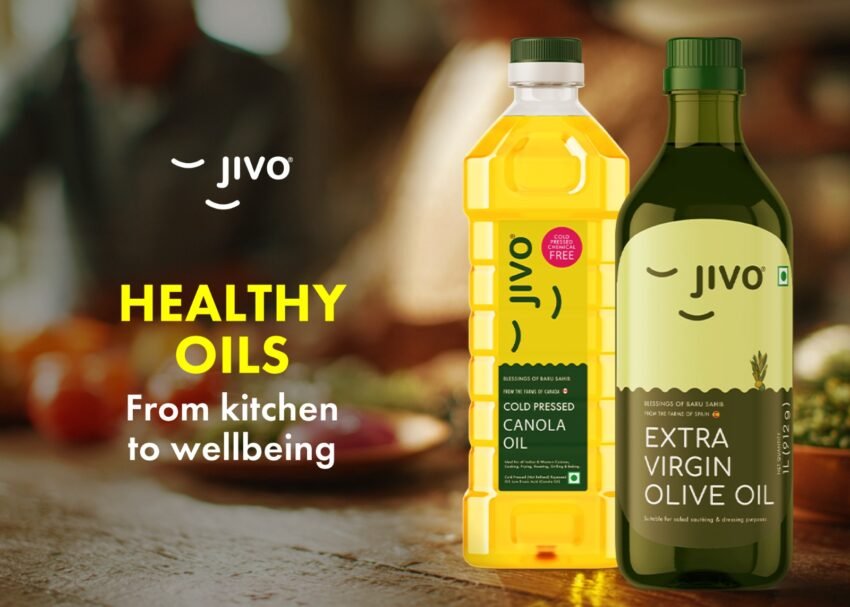
Known as the king of oils and globally renowned for its versatility, extra virgin olive oil (EVOO) is one of the best olive oil types, known for its healthy and natural nutrients. With high levels of MUFA, approximately around 70% to 75%, EVOO is extracted naturally, i.e., by pressing fresh olives under minimal heat without chemical refining. This ensures maximum nutrition retention, which is one of the key reasons that makes this oil the healthiest. Apart from healthy MUFA, specifically oleic acid, nutrients like polyphenols, tocopherols, vitamin K, and phytosterols are also major components in EVOO that make this oil nutritious and healthy. But there’s a limitation. EVOO is not suitable for high heat cooking; it’s ideal for low to medium heat cooking and best for salad dressing. The reason is its low smoke point, which doesn’t support high temperature cooking despite being rich in monounsaturated fats. What’s worth noting is the heart benefits EVOO holds. Studies confirm that consuming 20 grams of olive oil per day can reduce the chance of heart disease. EVOO is the best olive oils in India, renowned for its health-beneficial properties.
Cold-Pressed Canola Oil
Canola oil is one of the best cooking oils known for its heart-beneficial properties. Oleic acid in canola oil is known to reduce the risk of coronary heart disease. This oil has low levels of saturated fats, making it a popular oil for heart patients having high cholesterol levels. MUFA dominates the oil composition, followed by PUFA Omega-3 & 6 fatty acids, making it the oil of choice with balanced fats. It’s cold-pressed version is considered healthier due to its natural extraction process, which helps retain nutrients. This oil is perfect for Indian cooking as it has a high smoke point, which resists oxidation and complements frying, baking, sautéing, and deep frying without breaking down. Many health organizations have vouched for the heart benefits of canola oil and recommend replacing saturated fats with it as a healthy option. Dietitians recommend cold-pressed canola oil for boosting brain and heart functions. For heart patients diagnosed with high cholesterol levels, cold-pressed canola oil may be helpful if consumed in moderation as part of a balanced diet. For Indian cooking, this low-saturated fat, chemical-free cold-pressed oil is the healthiest option that suits versatile cooking.
These two cold-pressed oils are considered healthiest oils in India if bought from reputed cooking oil brands.
Unhealthy Oils to Avoid
Some oils cause more harm than good when used often. Highly refined seed oils like regular sunflower, soybean, or corn can oxidize quickly during repeated heating, creating unwanted by-products. Trans fats in vanaspati or certain margarines raise heart risks sharply and should be completely avoided. Palm oil, heavy in saturated fats, appears in many cheap blends but adds little benefit for long-term health. Reusing oil multiple times for frying also builds up toxins, so fresh batches make a big difference.