
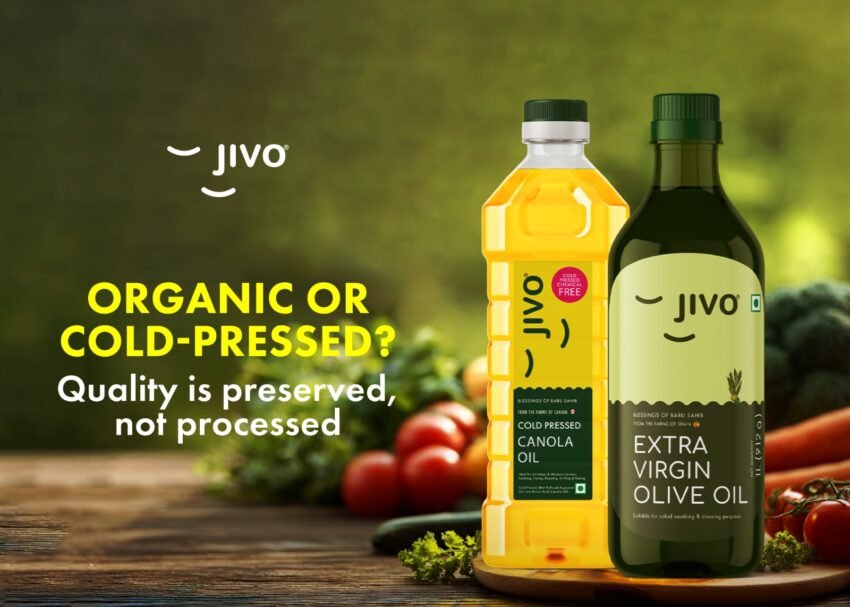
The best cooking oils in India are like silent heroes that provide daily nutrients. Whether it’s your morning breakfast or night dinner, cooking oil has its presence. If your cooking oil is healthy, and consumption is moderate, coupled with a healthy diet, your blood cholesterol levels are in control. But few know how to identify healthy cooking oils in India. Healthy oils refer to least processed oils, but what’s more you need to know here is the origin of the cooking oils, i.e., the cultivation of plant seeds. After all, it’s the plant seeds that are extracted to produce oil. Now, we have two aspects here – least-processed and non-GMO (genetically modified organism) oils.
Cold-pressed oils generally fall under least-processed oils, and the other, which is non-GMO, is referred to as organic oils. Organic oils can be cold-pressed, but not all cold-pressed oils are organic. The best organic cooking oil in India, if cold-pressed, is considered to hold maximum health benefits if consumed in moderation.
This blog discusses the differences between organic and cold-pressed oils, which helps readers make informed decisions about choosing the best cooking oils in India for preparing everyday meals.
What Are Organic Cooking Oils?
The best organic cooking oil in India is extracted from plant seeds that are grown naturally – organically. Plant seed cultivation falls under commercial crops, and to maximize yield, harmful chemicals like systemic insecticides (notably neonicotinoids), fungicides, nematicides, and various fumigants are used. These chemicals can degrade specific vitamins, minerals, and protective compounds. Once these chemicals are included in the cultivation of plant seeds, the output isn’t organic.
Organic cooking oils come from crops that are grown without any harmful chemicals. Even the seeds are not genetically modified. Organic farming of plant seeds involves natural composts like vermicompost, farmyard manure, leaf mould, and other chemical-free composts.
The natural method keeps the soil healthier, which, in the end, provides healthier crops. The output is organic, having very low chances of carrying leftover chemicals from farming. When these plant seeds are processed for oil extraction, you get organic cooking oils.
But what’s worth noting here is, organic oils, when highly processed, lose their nutritional integrity. Despite oil being organic, it has less nutritional value, and the chances of additional harmful substances are certain if it’s refined.
That’s why, the best cooking oils in India are those oils which involve crushing of plant seeds that are organically produced through the cold-pressing method.
In simple terms, organic plant seeds, when cold-pressed, offer the purest cooking oil.
Hence, we can say that the best cold-pressed oils in India are from organic plant seeds.
Make sure, you buy the best organic cooking oil in India from reputed cold-pressed brands to ensure safety and purity.
What Are Cold-Pressed Oils?
Cold-pressing is a procedure of oil extraction, which aims to retain nutrients without involving chemical refining or processing. Plant seeds are crushed under minimal temperature, i.e., below 49 degrees Celsius, to prevent depletion of vital nutrients like antioxidants, essential fatty acids, vitamins, bioactive compounds, and natural flavours. This is the reason why cold-pressed oils have a distinct flavour, make meals tasty, and are considered the healthiest oils in India.
Cold-pressed oils, especially canola oil, are now opted for by many health-conscious Indian families because of their balanced fats – monounsaturated fats (oleic acid) and polyunsaturated fats (alpha-linolenic acid), considered beneficial for heart health if consumed in moderation.
Many cold-pressed oils like extra virgin olive oil and mustard oil are also preferred for skincare because of their unsaturated goodness.
The best cooking oils in India are those that process organically grown plant seeds for cold-pressing. The produce that you get is pure and the healthiest version. This type of pure oil, if consumed in moderation, can do real health wonders. Prefer buying the best organic cooking cooking oil in India that’s cold-pressed for real health benefits and flavourful meals.
Also Read: What are cold pressed oils? How do these best oils benefit health?
Organic vs Cold-Pressed Oils: Key Differences
Many in India often get confused between organic cooking oils and cold-pressed oils. They are not the same thing. Organic refers to how crops (plant seeds) are grown, and cold-pressed refers to how plant seeds are treated to extract oil.
The tabular differentiation may help provide a clear insight.
| Aspect | Organic Oils | Cold-Pressed Oils |
| Farming vs processing | Focus on natural farming without chemicals or GMOs | Focus on gentle extraction without high heat or chemicals |
| Nutrients | Good retention if not heavily refined | Higher retention because of low heat |
| Taste | Mild to strong depending on refining | Richer and more natural flavour |
| Chemical exposure | Very low because of clean farming | Low because no solvents used |
| Shelf life | Shorter if unrefined | Shorter than refined oils but stable if stored well |
An oil can be both organic and cold-pressed, which would stand as the best cooking oil in India for health. The main point is that organic takes care of the farming side, while cold-pressed protects the goodness during extraction. When you compare organic vs cold-pressed oil, remember they solve different problems but, when used as a single combination, can boost overall health.
Which Is Healthier: Organic or Cold-Pressed Oils?
Both organic and cold-pressed cooking oil are good. If organic plant seeds undergo a heavy refining process, essential nutrients are lost. There’s no meaning left even after being organically grown. But if plant seeds are cold-pressed, nutrients stay intact and nothing is lost.
Being healthy or not depends on how the oil is extracted.
It’s the organic plant seeds which give pure oil. If a natural extraction method is adopted, like cold-pressing, the health-beneficial nutrients remain intact.
Even if genetically modified plant seeds are grown, they contain some levels of nutrients. These nutrients remain as they are if cold-pressed.
So, it’s the extraction process that matters. But of course, organic plant seeds are better, as these carry more high-quality nutrients. When these organic plant seeds are processed for oil extraction, through cold-pressing, the produce you get is the best organic cooking oil in India for overall wellness.
So, next time you buy cooking oil, look out for the terms ‘non-GMO’ and ‘cold-pressed,’ as these assure that you are buying the best cold-pressed oils in India.
Does Cooking Method Affect Oil Health?
The way you cook matters. Every oil has a smoke point. The smoke point refers to a temperature limit beyond which oil starts to break down, releasing harmful chemicals. Hence, it is important to cook meals within the temperature limit – the smoke point.
Be it organic or cold-pressed cooking oils, there’s no liberty on the smoke point. These oils will oxidize if heated above the smoke point. Nutrients deplete, emitting black smoke, and turning food rancid.
Extra virgin olive oil has a low smoke point, which means you cannot use this oil for deep frying at high temperatures. Mustard oil, on the other hand, has a higher smoke point, which supports high-heat cooking and maintains the oil’s stability.
It is important to know the smoke point of the oil you are using to prevent the formation of harmful compounds like acrolein, trans fat, and polar compounds. These compounds are unhealthy and cause heart problems. Reheating and reusing oils is also not recommended, as these too form harmful compounds.
Slow down the temperature knob when you see dark fumes. This means the oil has reached its smoke point.
The smoke point remains the same whether you use organic or cold-pressed oils. Mind the smoke point whenever deep frying.
Also Read: Why is the Smoke Point of Cooking Oils Important?
Best Oils for Daily Cooking
It is best to use cooking oils that are non-GMO and cold-pressed. This means, the oil is organic and retains higher levels of nutrients.
Cold-Pressed Canola Oil
Organic cold-pressed canola oil is good for heart patients. Canola has the lowest levels of saturated fat (7%), which means it’s good for your heart. High oleic canola oil is known to reduce the risk of coronary heart disease, as confirmed by the United States Food & Drug Administration. This oil has balanced fat levels – monounsaturated fats (MUFA) and polyunsaturated fats (PUFA), both known to contain oleic acid and alpha-linolenic acid, beneficial for the heart.
Since it is cold-pressed, it holds maximum nutritional value and has a high smoke point (around 242 degrees Celsius), making it perfect for high-heat cooking.
Organic cold-pressed canola oil is one of the best cooking oils in India, known to hold the potential to benefit heart health if consumed in moderation.
Extra Virgin Olive Oil
Organic extra virgin olive oil is widely considered good for heart health. It contains a high amount of monounsaturated fats (MUFA), especially oleic acid, which helps in managing bad cholesterol levels and supports overall heart function. Unlike refined oils, extra virgin olive oil is extracted without chemical processing, which helps retain its natural antioxidants like polyphenols and vitamin E.
Since it is cold-extracted, it preserves most of its nutritional value and natural flavour. However, it has a relatively lower smoke point (around 190–210 degrees Celsius), which means it is better suited for light cooking, sautéing, or salad dressings rather than deep frying at high temperatures.
Organic extra virgin olive oil is among the best cooking oils in India, known to support heart health and overall wellness when used in moderation.
Common Myths About Organic and Cold-Pressed Oils
When awareness is low about organic and cold-pressed oils, it is obvious for myths to surround.
Let us clear the mirror:
Organic means low fat – This is not true. All oils are made of 100% fats. Organic assures a cleaner source. That’s it. Fats and calories remain the same like other oils.
Cold-pressed oils cannot be used for cooking – Not true. Cold-pressed refers to a process of extracting oil from seeds. Cold-pressing is a natural process that helps retain nutrients. The purpose remains the same – cooking.
Refined and cold-pressed oils are same – Not true. Refined oils undergo chemical refining, solvent extraction, and are heated at multiple stages. Cold-pressed oils are extracted through a gentle process without chemicals and high heating, which ensures higher nutrient retention.
Go with the best cooking oils in India that are organic and cold-pressed, as these oils hold health-beneficial properties, beneficial for heart health and overall wellness.
Buy the Best Organic Cooking Oil in India
Organic and cold-pressed oils are not the same. Organic refers to cleaner cultivation of commercial plant seed crops, whereas cold-pressed refers to the method of extracting oil from plant seeds. The healthiest oil extract is cold-pressing organically produced plant seeds. Cold-pressed oils retain vital nutrients, maintaining the natural goodness of oil.
Non-GMO means oil is extracted from organically grown crops, and cold-pressed means oil is extracted naturally without chemical refining or processing. So, an ideal identification for buying the best cooking oils in India would be to check for the terms ‘non-GMO’ and ‘cold-pressed’. You can buy the best organic cooking oil in India from reputed oil brands like Jivo. Jivo offers non-GMO certified, cold-pressed oils that are best for everyday Indian cooking. Two of its popular oils you can try are – cold-pressed canola oil and extra virgin olive oil. To know more about Jivo’s best cold-pressed oils in India, click HERE.
Read informative blogs on cooking oils and nutritional products, to buy the best cooking oils in India.