
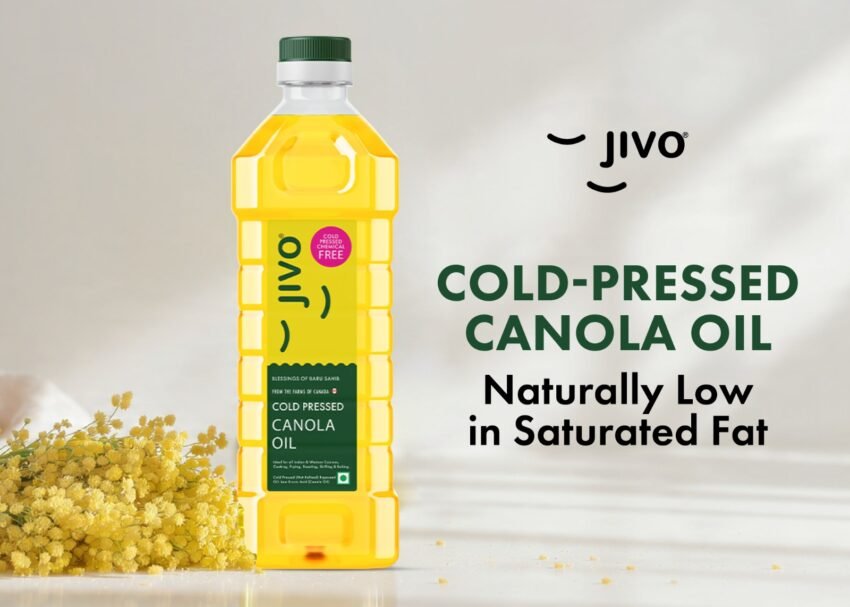
Cooking oils are dominated by fatty acids. Monounsaturated fats (MUFA), polyunsaturated fats (PUFA), and saturated fats (SFA) are the three main types of fats present in cooking oils. Each fat plays a significant role, positive when consumed in moderation. Among these, saturated fat is recommended to be at lower levels as this type of fat is linked with raising bad (LDL) cholesterol levels, which happens when arteries are blocked. So, the best cooking oils in India mostly have lower levels of saturated fats, especially cold-pressed canola oil. Going with low saturated fat oil for cooking in India, which is cold-pressed, is one of the best ways to support heart health.
What does low saturated fat mean?
When we refer to low in saturated fat oil for cooking, it simply means that only a small portion of the fat in the oil comes from saturated sources. An oil has more amounts of unsaturated fats, which are generally considered healthy for cooking.
Every cooking oil contains a mix of fats. The difference is, how much of each type of fat is present. Oils higher in saturated fat can contribute to an increase in LDL, also known as bad cholesterol, when used regularly in large amounts. In contrast, oils lower in saturated fat tend to support a more balanced cholesterol profile.
This is why many people look for a heart-healthy oil that is naturally lower in saturated fat. It allows you to continue enjoying your regular meals while making a smarter choice in the background.
In the context of Indian cooking, where oil is used daily for tadka, frying, and curries, even a small improvement in fat quality can add up over time. Choosing the best cooking oil for heart health in India often comes down to this simple factor, keeping saturated fat lower while maintaining a good balance of other fats.
Cooking oils contain different types of fats.
- Saturated fats – should be limited in daily intake
- Unsaturated fats – considered a better choice for regular use
How saturated fat impacts heart health
Low saturated fat oil for cooking is recommended. But if it is high and consumed in excess through dietary intake, can cause heart problems.
The type of fat you consume daily has a direct effect on how your heart functions over time. Saturated fat, when taken in higher amounts, can contribute to increase the levels of low-density lipoprotein (LDL) cholesterol.
When your diet contains more saturated fat, it can raise LDL, commonly known as bad cholesterol. Excess LDL can start depositing along the walls of arteries, gradually making them narrower. As these passages tighten, blood finds it harder to flow smoothly.
This puts extra pressure on the heart, as it has to work harder to pump blood through the body. Over a long period, this added strain can increase the risk of conditions like high cholesterol and coronary artery disease.
It is worth noting that, repeatedly heated cooking oils can increase the saturated fat intake, including trans fat. Hence, this needs to be completely avoided. This is where choosing oil good for heart with low saturated is considered healthy and safe.
Making a shift to the best cooking oil for heart health in India, especially one that is lower in saturated fat, is a practical way to support better heart function without changing your meals completely.
Which fats benefit heart health?
Not all fats are harmful. In fact, your body needs certain fats to function properly. The key is choosing the right type of fat in your daily cooking – low saturated fat oil for cooking in India.
Fats that are considered good for heart health are mainly unsaturated fats. These are commonly found in oils like canola, sunflower, and olive oil. Unlike saturated fats, they help maintain a healthier balance of cholesterol in the body when consumed in moderation.
There are two main types of unsaturated fats:
Monounsaturated fats (MUFA): These help manage LDL, often referred to as bad cholesterol, while supporting overall heart function.
Polyunsaturated fats (PUFA): These include essential fatty acids that the body cannot produce on its own and need to be consumed through food.
Including these fats in your meals through a heart-healthy oil can support better cholesterol balance over time.
In Indian cooking, where deep frying in involved, choosing the best cooking oil for heart health in India with lower saturated fat level in recommended.
The science: low-saturated fats vs. high-saturated oils
The difference between oils comes down to their fatty acid profile, which simply means the proportion of different types of fats present in the oil. This balance plays an important role in how the oil interacts with your body.
Low-saturated fat oils contain a higher share of unsaturated fats. These fats are more fluid in nature and are easier for the body to handle when it comes to maintaining cholesterol balance. As a result, they are often preferred as a heart-healthy oil for regular use.
On the other hand, oils and fats that are high in saturated fat have a more rigid structure. When consumed frequently in large amounts, they can contribute to higher LDL levels. Over time, this may influence how fats are deposited in the body, including along artery walls.
To understand this better, here is a simple comparison of commonly used fats:
| Oil Type | Saturated Fat | What it means |
| Canola Oil | ~7% | Lower saturated fat, more balanced profile |
| Olive Oil | ~14% | Rich in monounsaturated fats |
| Sunflower Oil | ~10% | High in polyunsaturated fats |
| Ghee | ~+60% | High in saturated fat |
Top heart risks linked to high saturated fat intake
The impact of saturated fat is not about one meal. It builds gradually through daily food habits. When intake stays high over time, it can affect how your heart and blood vessels function.
Here are some of the common risks linked to higher saturated fat intake:
Rise in bad cholesterol levels
Diets high in saturated fat can increase LDL, often called bad cholesterol. When LDL levels rise, it becomes easier for fat to accumulate inside blood vessels.
Narrowing of arteries
As fat deposits build up along artery walls, the space for blood flow becomes smaller. This can affect how efficiently oxygen and nutrients reach different parts of the body.
Increased strain on the heart
When blood flow is not smooth, the heart has to work harder to pump blood. Over time, this added effort can affect overall heart function.
Higher long-term heart risk
If these changes continue over a long period, they may increase the risk of conditions like coronary artery disease and high cholesterol.
Impact of everyday food habits
In Indian diets, frequent consumption of deep-fried snacks, rich gravies, and repeated reheating of oil can increase overall saturated fat intake without being noticed.
This is why choosing a heart-healthy oil becomes important. Switching to the best cooking oil for heart health in India, especially one that is lower in saturated fat.
Cholesterol benefits of low-saturated fat oils
The type of oil you use every day plays a direct role in how your body manages cholesterol. Choosing oils that are lower in saturated fat can help maintain a healthier balance between different types of cholesterol.
One of the key benefits is better control over LDL, often called bad cholesterol. Diets that include lower saturated fat can help keep LDL levels from rising too much, which supports cleaner blood vessels over time.
At the same time, these oils help maintain HDL, known as good cholesterol. HDL works by carrying excess fat away from the arteries, which helps in keeping them clearer.
Another advantage is the presence of unsaturated fats, including essential fatty acids. These fats support normal body functions and contribute to overall cardiovascular health when used as part of a balanced diet. Switching to healthy unsaturated fats and replacing/lowering saturated fats may help prevent cardiovascular disease in adults with type-2 diabetes.
Choosing cooking oil good for heart having a balanced fat profile makes it easier to manage cholesterol through everyday meals.
In the context of Indian cooking, where oil is used daily, choosing the best cooking oil for heart health in India may help manage cholesterol better.
Switching to oils lower in saturated fat can help:
- Maintain healthier LDL levels
- Support HDL (good cholesterol)
- Provide essential fatty acids
This supports overall heart health when combined with a balanced diet.
Why cold-pressed canola oil is a smart choice for heart health
If you are looking for a low saturated fat oil or heart-healthy oil for cooking that fits easily into everyday Indian cooking, cold-pressed canola oil is a practical option to consider.
One of its key advantages is its fat composition. It is naturally low in saturated fat and contains a higher proportion of unsaturated fats, which helps support better cholesterol balance when used regularly as part of your diet.
The cold-pressing process also plays a role. Since the oil is extracted with minimal heat, its natural fat structure remains closer to its original state. This means the balance of fats stays intact without heavy processing.
Another benefit is its light taste. It does not overpower the flavour of food, making it suitable for a variety of dishes such as sabzi, dals, and even light frying. This makes it easier to switch without changing your usual meals.
For those searching for the best cooking oil for heart health in India, cold-pressed canola oil offers a simple way to improve fat quality in daily cooking.
A small shift in the type of oil you use can support better heart health over time, without requiring major changes to your diet.
Also Read: Cardiologist Reveal Best Cooking Oils in India to Support Long-Term Heart Health
Cold-pressed canola vs. regular canola oil
Both cold-pressed and regular canola oil come from the same seed, but the difference lies in how the oil is extracted and processed. This processing method affects taste, texture, and certain natural components in the oil.
How they are made
Cold-pressed canola oil is extracted by mechanically pressing the seeds at low temperatures. This method avoids heavy heat and chemical treatment, so the oil remains closer to its natural form.
Regular canola oil, which is commonly available in the market, goes through refining. This includes steps like heating, filtering, and sometimes solvent extraction to make the oil clear, neutral in taste, and more stable for storage.
Difference in composition and retention
Because cold-pressed oil is minimally processed, it retains more of its natural compounds such as antioxidants, vitamin E, and plant sterols. These components are reduced during refining, as the process removes many non-fat elements along with impurities.
Refined canola oil, on the other hand, is more uniform in texture and has a longer shelf life, but with fewer of these naturally occurring compounds.
Taste and cooking experience
Cold-pressed canola oil has a mild, slightly nutty flavour. It can add a subtle taste to dishes, especially in light cooking.
Regular canola oil is neutral in flavour and smell, which makes it suitable for recipes where you do not want the oil to influence taste.
Heat stability and usage
Refined canola oil generally has a higher and more stable smoke point, making it more suitable for high-heat cooking like deep frying.
Cold-pressed versions are better suited for moderate heat cooking, sautéing, or everyday use where the oil is not overheated.
What it means for your kitchen
Both types can be part of a balanced cooking routine. The choice depends on how you cook and what you prefer.
- For everyday meals and lighter cooking, cold-pressed canola oil can be a good fit as a heart-healthy oil
- For high-heat cooking, refined canola oil may be more practical
For those looking for the best cooking oil for heart health in India, understanding this difference helps in choosing the right oil for the right purpose rather than relying on just one type for everything.
What makes an oil heart-healthy?
A heart-healthy oil is about overall balance.
Look for oils that:
- Are lower in saturated fat
- Contain a mix of unsaturated fats
- Fit your cooking style
- Also, avoid reheating oil multiple times.
Also Read: 10 Best Heart-Healthy Indian Recipes Using Cold-Pressed Canola Oil
Conclusion
You might have to spend a bit more on cold-pressed oils but it’s worth it. Your health is far more precious. The present era is about making careful choices, especially when adulteration and fake products are on the rise. Cooking oils play a silent, but major role in everyday life because we consume them through meals. High saturated fat oils, in the long run, can adversely impact heart health, clogging arteries. You need to be careful while buying edible oils. Go for naturally extracted cold-pressed oils, especially canola, if you are looking for long-term heart health. To get the real benefits, moderate consumption is advised, and for heart patients, consulting a cardiologist is highly recommended before making the switch.
Not all oil brands in India offer cold-pressed canola oil. Prefer buying from the top cold-pressed oil brands in India like Jivo. Jivo is known for its diverse range of cold-pressed oils, all fortified with vitamin A & D. Its cold-pressed canola oil leads the cold-pressed segment. It’s one of the best cold-pressed oils in India, having a pan-India presence.
Try Jivo’s cold-pressed canola oil for a few months and experience the difference.