
India has less than 20 percent of the world’s population, but according to the Indian Heart Association, Indians account for close to 60 percent of the world’s heart disease burden. A 2025 government survey also reported a sharp increase in heart disease cases over the past seven years. What is even more concerning is that heart-related problems are no longer something we associate only with older people. An ICMR-backed autopsy study at a major Delhi hospital found that heart-related causes were responsible for 42.6 percent of sudden deaths in young adults, with coronary artery disease accounting for most of these cases.
When someone in the family develops a heart problem, we naturally start looking at our lifestyle. Are we eating too much outside food? Are we exercising enough? Is stress affecting us? Genetics also play a role. But there is one everyday ingredient that often gets overlooked, it is the cooking oil.
Think about how often oil is used in an Indian home. We use it for making breakfast, lunch, and dinner. Yet most of us rarely check what type of oil we are using or how it has been processed.
For many families, the choice is quite simple. We buy the same oil our parents used, pick up the brand available at the local grocery store, or choose a product because we saw an advertisement saying it is good for the heart. But cooking oil is something we consume regularly, so it is worth knowing a little more about what we are actually buying.
In this guide, we will look at some of the best cooking oils in India, understand the difference between cold pressed and refined oils, and see how to choose a cholesterol-free cooking oil that suits your everyday Indian cooking.
Why the Oil You Choose Actually Matters
Every cooking oil contains different types of fat, mainly saturated fat, monounsaturated fat (MUFA), and polyunsaturated fat (PUFA). Eating too much saturated fat can increase LDL cholesterol, which is often referred to as bad cholesterol. Unsaturated fats, when used instead of saturated fats, are generally considered a better choice for maintaining a healthy lipid profile.
One thing many people don’t know is that plant-based cooking oils do not naturally contain cholesterol. Cholesterol mainly comes from animal-based foods such as ghee, butter, and meat. So, technically, vegetable oils are cholesterol-free cooking oils. What makes one oil different from another is its fat profile, the natural compounds it contains, and how it is processed before it reaches your kitchen. This is where the difference between cold pressed and refined oils becomes important.
Cold Pressed vs Refined Oil, What Is the Real Difference
Refined oils go through a long industrial process involving high heat, chemical solvents like hexane, and bleaching agents to give the oil a neutral smell, long shelf life, and clear colour. This process is efficient for mass production, but it strips away a good portion of the oil’s natural vitamins and antioxidants along the way.
Cold pressed oils are made differently. Seeds or nuts are pressed mechanically at low temperature, without solvents, which keeps much more of the oil’s original character intact, including vitamin E, polyphenols, and other protective plant compounds. A comparative study published in Scientific Reports found that Indian cold pressed oils showed markedly higher antioxidant activity than their refined counterparts, largely because refining removes many of the bioactive compounds that would otherwise protect the oil, and by extension, your body, from oxidative damage. A broader review in the Journal of Food Science and ScienceDirect confirms the same pattern across different oil types, cold pressing consistently retains more of the natural antioxidants that get lost during chemical refining.
This does not mean refined oils are unsafe. It simply means cold pressed oils give you a little extra nutritional value.
ALSO READ: 3 Best Cold-Pressed Oils in India Fortified with Vitamin A & D
The Best Cooking Oils in India for Heart Health
There is no single perfect oil that works for every dish and every kitchen. Indian cooking is far too diverse for that. The smarter approach, and the one most nutrition experts quietly agree on, is rotating between two or three oils depending on what you are cooking. Here are the ones worth knowing about.
1. Cold Pressed Mustard Oil
Mustard oil has been a regular part of Indian kitchens for generations. It has a strong, sharp flavour that many families are familiar with, and its fat profile is also worth considering. Mustard oil contains a good amount of monounsaturated fat (MUFA) along with omega-3 fatty acids, making it different from many other commonly used cooking oils.
There is also some interesting research on mustard oil and heart health. In the Indian Experiment of Infarct Survival, published in PubMed, researchers studied patients with suspected heart attacks and found that those given mustard oil had fewer total cardiac events, non-fatal heart attacks, arrhythmias and cases of angina than the placebo group over one year. However, the study did not find a significant reduction in cardiac deaths with mustard oil, so these findings should not be taken as proof that mustard oil prevents heart disease. More recent research has also discussed the presence of erucic acid in mustard oil and questions around its long-term effects. A review in the Journal of Clinical Lipidology highlights this ongoing discussion, which is one reason why using mustard oil in moderation and rotating it with other oils can be a sensible approach.
Mustard oil has a strong pungent taste and a high smoke point, making it suitable for many everyday cooking methods. It works particularly well for tadka, pickles, fish curries and stir-fries, especially when you want that familiar mustard flavour in your food.
2. Cold Pressed Groundnut (Peanut) Oil
Groundnut oil is widely used in Indian kitchens and is a practical option for everyday cooking. It has a relatively high smoke point, which makes it suitable for cooking methods that require higher temperatures, including frying.
Research on peanuts has also shown some interesting results. A systematic review and meta-analysis published in PMC found that regular peanut consumption was associated with lower triglyceride levels and some improvements in cholesterol-related measures. However, it is important to note that these studies looked mainly at whole peanuts, peanut butter and other peanut products, not groundnut oil itself. The researchers specifically excluded studies that examined peanut oil. So, these findings should not be presented as direct evidence that groundnut oil lowers cholesterol or triglycerides.
Groundnut oil does, however, contain a good amount of monounsaturated fat (MUFA). A review published in the journal Lipids found that diets higher in MUFA, particularly when MUFA replaces saturated fat, can have a favourable effect on blood lipids and other cardiovascular risk factors. Groundnut oil is also naturally cholesterol-free and contains vitamin E. For regular Indian cooking, including sabzis, sautéing and occasional frying, cold pressed groundnut oil can be a practical choice when used in moderation.
3. Cold Pressed Sesame Oil (Til or Gingelly Oil)
Sesame oil has been used in Indian cooking for generations. It has a distinct flavour and contains naturally occurring compounds such as sesamin and sesamol, along with both monounsaturated fat (MUFA) and polyunsaturated fat (PUFA).
Research on sesame has also shown some interesting results. A meta-analysis published through PubMed found that sesame consumption was associated with reductions in both systolic and diastolic blood pressure across several controlled trials. However, these findings relate to sesame consumption and should not be taken as direct evidence that sesame oil itself lowers blood pressure. A separate clinical study published in PMC looked at people with high blood pressure who replaced their regular cooking oil with sesame oil and reported improvements in blood pressure and some markers of oxidative stress. While these findings are interesting, more research is needed to understand the specific effects of sesame oil.
Cold pressed sesame oil has a strong, distinctive taste, which makes it particularly suitable for tempering, chutneys and adding flavour to dals and other traditional dishes.
4. Cold Pressed Canola Oil
Canola oil is not a traditional Indian cooking oil, but it can work well in everyday cooking. It has a relatively low amount of saturated fat and is a good source of monounsaturated fat (MUFA), along with omega-3 and omega-6 fatty acids. Its mild taste also makes it suitable for cooking without changing the flavour of your food.
A systematic review and meta-analysis of randomised controlled trials published on PubMed looked at 27 trials involving 1,359 participants. The researchers found that canola oil consumption was associated with lower total cholesterol and LDL cholesterol. The study also found that these reductions were seen when canola oil was compared with sunflower oil and saturated fat. However, canola oil did not significantly change HDL cholesterol or triglyceride levels.
The cold-pressed version of canola oil is picking up popularity owing to its minimal processing and cooking versatility in the Indian kitchen.
5. Cold Pressed Coconut Oil
Coconut oil holds a special place in Kerala, coastal Karnataka, and Tamil Nadu, and it comes with a genuine caveat worth understanding rather than ignoring. It is high in saturated fat, higher than most other vegetable oils, so it should be used thoughtfully rather than as your only cooking oil.
That said, cold pressed coconut oil contains medium chain triglycerides, a type of fat that the body metabolises quickly for energy rather than storing it the way it handles other fats. It also has natural antimicrobial properties from lauric acid. The honest advice here is to enjoy coconut oil for the dishes it is meant for, coastal curries, chutneys, and traditional stir fries, and balance it out with a lighter oil like groundnut or canola for the rest of your cooking.
6. Extra Virgin Olive Oil
Olive oil is not native to Indian cooking, but it has earned its place at the table because the evidence behind it is genuinely strong. It is loaded with oleic acid, a monounsaturated fat that has been studied more extensively than perhaps any other fat in nutrition science.
The famous PREDIMED trial, published through PMC, followed thousands of people over several years and found that higher olive oil intake was linked to a meaningfully lower risk of cardiovascular events and overall mortality. A separate meta-analysis of cohort studies confirmed similar protective associations between MUFA rich diets, particularly from olive oil, and better cardiovascular outcomes. Extra virgin olive oil is best used for salad dressings, light sautéing, or drizzling over finished dishes, since its delicate compounds do not hold up well under high heat for long durations.
How to Actually Pick the Right Oil for Your Kitchen
It is better to rotate oils than sticking to one particular oil brand and type.
For daily tadka, pickles, and Bengali or Punjabi style cooking, cold pressed mustard oil is a natural fit. For deep frying and Gujarati or Maharashtrian dishes, cold pressed groundnut oil handles the heat well. For South Indian tempering and chutneys, cold pressed sesame oil brings both flavour and antioxidant benefits. For everyday sautéing where you want a neutral taste, cold pressed canola oil works quietly in the background. For coastal curries and traditional Kerala or Tamil dishes, cold pressed coconut oil in moderation adds authentic flavour. And for salads and finishing touches, extra virgin olive oil rounds things off nicely.
Rotating oils this way means you are not relying on a single fat profile for every meal of the week, and you naturally end up with a more balanced intake of MUFA, PUFA, vitamin E, and the many plant compounds that get lost in heavily refined oils.
ALSO READ: How to Choose the Best Cooking Oils in India
What to Avoid Along the Way
Vanaspati, hydrogenated oils, and anything with partially hydrogenated fat listed on the label should stay out of your kitchen entirely. These contain trans fats, which raise LDL cholesterol while also lowering HDL cholesterol, a double blow that no amount of good oil elsewhere in your diet can fully offset. Reused frying oil is another quiet culprit, repeated heating breaks down the oil’s structure and creates harmful compounds, so it is worth resisting the temptation to save that leftover oil from your last fry.
ALSO READ: Best Cooking Oils for Health
A Few Practical Habits That Make a Real Difference
Oil quality matters, but so does how you use it. Cooking oil is still calorie dense, so even the healthiest cold pressed oil deserves to be used in sensible quantities rather than generously poured. Storing oil away from direct sunlight and heat helps preserve its natural antioxidants for longer, since light and warmth speed up oxidation. Buying smaller bottles more frequently, rather than one large tin that sits open for months, also keeps the oil fresher through its shelf life.
FAQs
What is the best cooking oil in India?
There is no single best cooking oil for every Indian kitchen. The right choice depends on your cooking method, flavour preference, and nutritional needs.
What are the best cold-pressed cooking oils?
Cold-pressed canola, mustard, groundnut, sesame, and coconut oils are popular choices. Each has a different flavour, fatty-acid profile, and cooking suitability.
Is cold-pressed oil better than refined oil?
Cold-pressed oils are produced using mechanical pressing with minimal processing. Refined oils undergo additional processing, so the two differ in how they are produced and what characteristics they retain.
Conclusion
For heart health, it is for sure that highly-processed oils are not the ones you need to opt for. Minimally processed, like the kachi ghani or the cold-pressed oils are the best fit. Cold pressed mustard, groundnut, sesame, and canola oils each bring something different to the table, all of them naturally cholesterol free, and rotating between them based on what you are cooking is a simple, sustainable way to support your heart over the long run. Small, consistent choices at the stove tend to matter far more than any single dramatic change, and switching to cold pressed oils is one of those quiet upgrades that pays off gradually, one meal at a time.
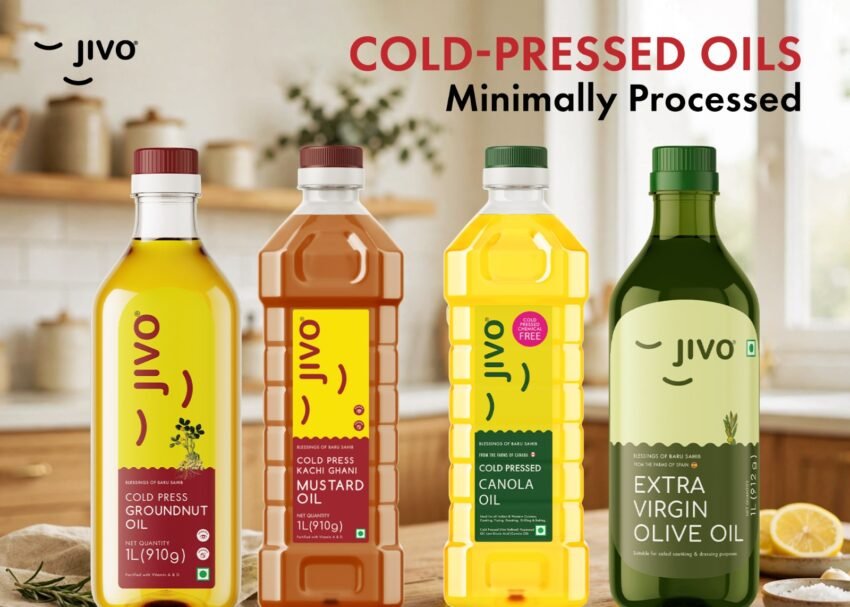
Jivo is one of the reputed oil brands in India, known for its diverse range of cold-pressed oils. Its cold-pressed canola oil has gained nation-wide popularity with a wide network of distributors. Most of the oils are imported and traditionally prepared, making them a feasible choice of everyday cooking.
You may also try cooking oils free of cholesterol and trans fats, available to order online from Zepto and Blinkit for quicker delivery: Jivo EVOO and Extra Light Olive Oil.
Disclaimer:
This article is meant for general awareness and does not replace medical advice. Please consult a qualified doctor or nutritionist before making significant changes to your diet, especially if you have an existing heart condition.