
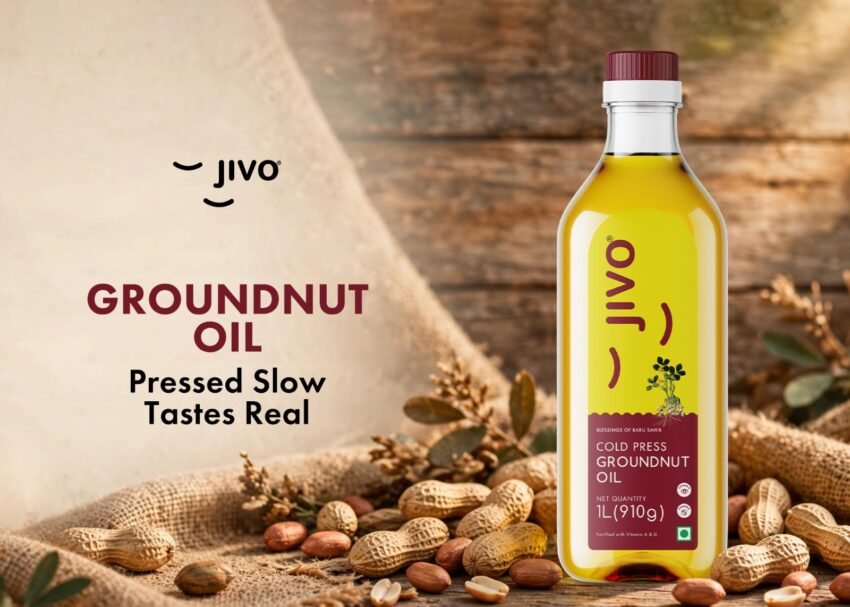
Groundnut oil is one of the best cooking oils in India cherished for its nutty flavour. India’s groundnut oil consumption stood at about 1.1 million metric tons in marketing year 2023 to 2024, and it remains one of most preferred edible oils in southern and western states even in 2026. With so many cooking oil types, from refined bottles to cold pressed oils sold as a healthier option, most people are still confused as to which is the best cooking oil having health-beneficial properties. Between refined and cold-pressed, nutrition science provides a better picture, making it easy for the consumers to buy the best groundnut oil in India.
What Refined Oil Actually Goes Through
Let us begin with refined oil, since it is used in most Indian cooking. The seeds are pressed at high temperature and the oil is treated further to remove colour, smell and impurities. This includes steps like bleaching and deodorising. It sounds unnatural and highly processed, but the fact is, it is sold at large scale in India. Even the best oil brands in India do this mainly because it gives a longer shelf life and a neutral taste suited for large scale cooking. That said, this highly-processed industrial method depletes several natural compounds in the due course hinting about a different story all together.
How Do Cold-Pressed Oils Preserve Nutrients Better than Refined Oils in India
How Cold Pressing Is Different
Cold pressing of plant seeds works differently and is a natural process of extracting oil. The oil is extracted by simply crushing the groundnuts under mechanical pressure, without adding heat or any chemical solvent. Nothing gets bleached and nothing gets deodorised. What you end up with is oil that keeps its natural colour, aroma and taste. This is one reason people go looking for the best groundnut oil in India that is genuinely cold pressed rather than something labelled that way for marketing purposes alone. It is a slower process and it costs more. But quality comes with a price.
ALSO READ: What are cold pressed oils? How do these best oils benefit health?
Cold Pressed Vs Refined Groundnut Oil At A Glance
Since people usually want a quick side by side view before reading further, here is how the two actually compare.
| Feature | Cold-Pressed Groundnut Oil | Refined Groundnut Oil |
| Extraction Method | Mechanically crushed at low temperature | Pressed at high heat, then chemically refined |
| Chemicals Used | None | Bleaching and deodorising agents |
| Natural Colour & Aroma | Deep golden colour with a strong peanut aroma | Pale colour and largely odourless |
| Vitamin E Retention | Higher, as heat-sensitive nutrients are better preserved | Lower, due to heat and chemical refining |
| Smoke Point | Slightly lower | Higher |
| Best Suited For | Tempering, light sautéing, everyday cooking | Deep frying and continuous high-heat cooking |
| Peanut Allergy Safety | Not considered safe, as allergenic proteins may remain | Generally considered safer, as most allergenic proteins are removed |
| Shelf Life | Shorter | Longer |
| Price | Higher | Lower |
Groundnut Oil vs. Cold-Pressed Groundnut Oil: Which Is Healthier for Your Kitchen?
What Is Actually Inside Groundnut Oil
Now let us talk about what is actually inside groundnut oil, since this is where things get interesting. Groundnut oil contains a good mix of fats, and most of it falls under the monounsaturated category, the kind generally considered a better option. There is also a fair amount of polyunsaturated fat and a smaller share of saturated fat. This exact fat breakdown is documented in the USDA database, which is the standard reference nutritionists rely on for such figures. This balance is one reason many people consider it among the better options when picking the best groundnut oil for cooking daily meals, especially compared to oils that are heavier in saturated fat content.
What The Research Actually Says
A review published on PubMed, the medical research database run by the National Center for Biotechnology Information, describes groundnut oil as having a well balanced fatty acid and antioxidant profile that may offer some protection against free radicals. It also supports the idea that groundnut oil, in general, deserves its place among the better cooking oil choices available to Indian households, whether you eventually choose the best groundnut oil that is refined or the unrefined version instead.
The Vitamin E Angle Most People Miss
Vitamin E is another part of this story people often skip over. Groundnut oil naturally contains vitamin E, which works as an antioxidant in the body. According to the vitamin E fact sheet published by the National Institutes of Health, vitamin E plays a role in immune function and helps protect cells from oxidative stress. This is not specific to groundnut oil alone, it is simply what vitamin E does wherever it appears in the diet.
The reason for that difference comes down to basic food science rather than anything mysterious. Refining involves higher temperature and chemical treatment, and these steps are known to break down heat sensitive nutrients like vitamin E over time. Cold pressing skips all of that, so naturally more of the original nutrient content survives the process. I want to be honest here though, there is not a large body of direct clinical research comparing cold pressed and refined groundnut oil side by side in controlled human trials, so this remains a reasonable and science backed assumption rather than a fully proven fact.
Refined Or Cold Pressed Which One Should You Actually Cook With
This brings us to a genuine question many people ask me. Is the best groundnut oil for cooking always the cold pressed one. Honestly, it depends on what you are making. Refined groundnut oil has a higher smoke point, so it holds up better during deep frying and long hours of continuous heat without breaking down quickly. Cold pressed oil has a slightly lower smoke point and a much stronger flavour, so it suits tempering dal, light sautéing and everyday sabzi far better than it suits a big batch of deep fried snacks.
How To Spot Genuine Groundnut Oil In India
If you are trying to find the best groundnut oil in India for your own kitchen, there are a few practical things worth checking rather than trusting whatever looks appealing on the label. Look for the FSSAI licence number on the packaging, since that is mandatory for any packaged food sold in the country. Genuine cold pressed oil usually has a deep golden colour and a noticeable peanut smell, while refined oil looks almost clear and has very little smell of its own. If a bottle claims to be cold pressed but looks pale and odourless, that is worth questioning before you buy it.
Is The Extra Cost Actually Worth It
There is also a cost angle that people tend to underestimate when they go searching for the best groundnut oil for cooking on a regular basis. Cold pressed oil usually costs more per litre compared to refined oil, and I think that is a fair trade for many households, though not for everyone. If your family fries snacks often and in large quantities, spending extra on an expensive cold pressed oil purely for frying might not make much financial sense in the long run.
A more practical approach that many nutritionists suggest is using a cheaper refined oil for heavy frying and keeping a bottle of cold pressed oil for tempering, light sautéing or dishes where the flavour of the oil actually matters. This way you get some nutritional benefit without overspending on something that will just be used to fry pakoras every other day. It also means you are not forced to pick just one bottle and call it the single best groundnut oil for your entire kitchen.
Do Not Fall For The Miracle Oil Hype
People sometimes talk about cold pressed oil as if it is some kind of miracle product that fixes cholesterol overnight or prevents heart disease all on its own. That is simply not how nutrition works in real life. Groundnut oil, cold pressed or refined, is still a source of fat and calories at the end of the day, and treating any single ingredient as a cure for poor eating habits is misleading, no matter how good that ingredient actually is.
The honest picture is that switching to a better quality oil is one small piece of a much bigger puzzle, and it works best as part of an overall balanced way of eating rather than a standalone fix. So how do you actually use this information in daily life. If you fry often, keep a bottle of refined groundnut oil at home for that purpose, since its higher smoke point makes it practical and it is also usually easier on the wallet.
If you care about flavour and want a bit more nutritional value from your everyday cooking oil, keep a second bottle of the best cold pressed groundnut oil you can find for tempering dal, making light sabzis or simply drizzling over a finished dish. Many nutrition experts in India also recommend rotating between two or three oils instead of depending on just one, since no single oil gives your body every nutrient it needs on its own, and groundnut oil works well as part of that rotation.
Mustard oil, sesame oil and groundnut oil each bring something slightly different to the table, and using a mix through the week is a fairly sensible approach for most Indian families. I do not think there is one single best groundnut oil that works for every household and every situation. What actually works is understanding how each type is made, what nutrients it holds on to, and matching that to your own cooking habits instead of blindly following whatever trend happens to be popular that month.
ALSO READ: Does Groundnut Oil Boost Brain Health? A Simple Guide to Its Benefits
Conclusion
At the end of the day, there is no single cooking oil that works perfectly for every kitchen. The best groundnut oil for cooking depends on what you are preparing and what matters most to you. If deep frying is part of your routine, refined groundnut oil can be a practical choice. But if you prefer an oil that is minimally processed and retains its natural flavour and nutrients, cold-pressed groundnut oil is well worth considering.
Instead of chasing big health claims, focus on choosing an oil that matches your everyday cooking style and comes from a brand you can trust. That is often the smartest way to find the best groundnut oil in India for your family’s needs.
For those who prefer cold-pressed oils, Jivo Cold-Pressed Groundnut Oil is prepared the traditional way without high-heating. Whether you are making dal, sabzi, or your favourite homemade recipes, it is a simple way to bring quality and authentic flavour to your everyday meals.
You may also try cooking oils for frying, free of cholesterol and trans fats, available to order online from Zepto and Blinkit for quicker delivery: Jivo EVOO and Extra Light Olive Oil.